Daily Current Affairs (18.08.2026)
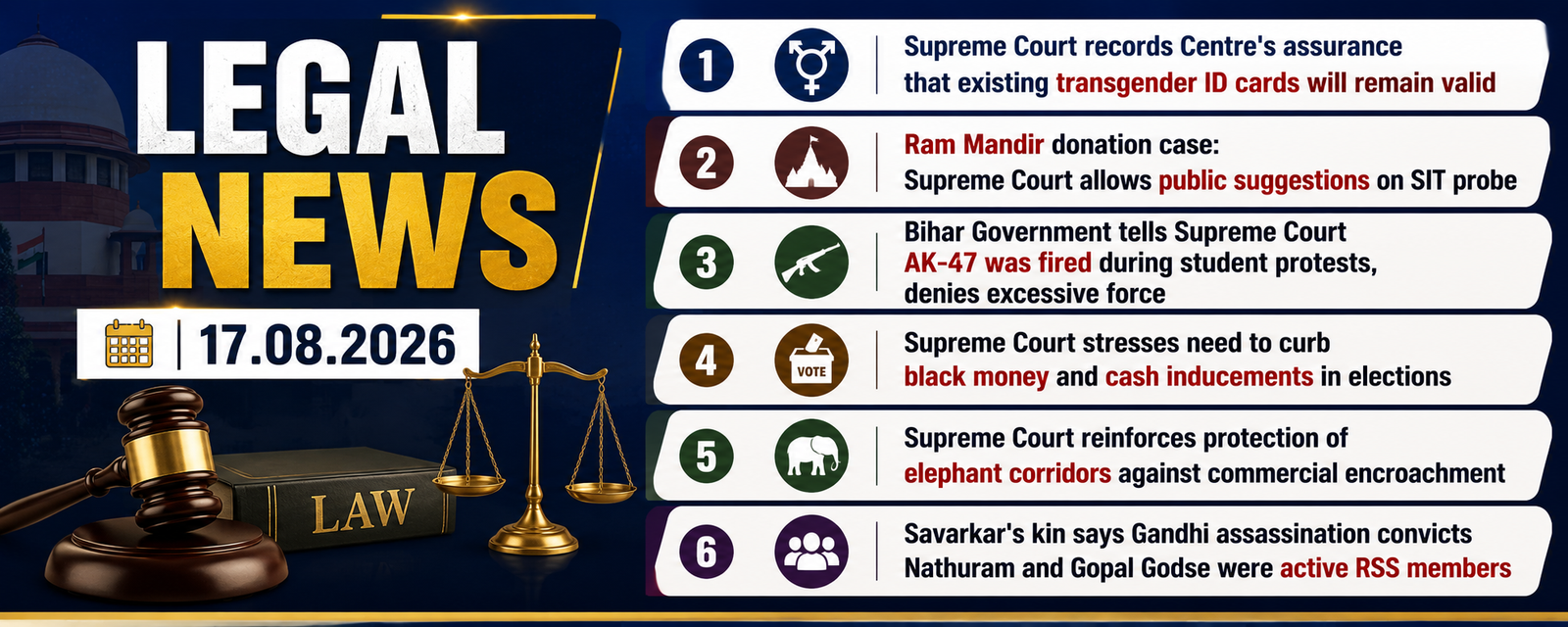
1. Supreme Court declines plea to abolish hanging, leaves alternative execution methods to Parliament
Keywords: Death Penalty, Hanging, Article 21
The Supreme Court has dismissed a petition seeking abolition of death by hanging as a method of execution in India, while making it clear that the question of adopting an alternative method remains open for consideration by the legislature. A Bench comprising Justices Vikram Nath and Sandeep Mehta held that courts cannot dictate to Parliament which specific method should be prescribed for carrying out a death sentence. The petition had sought replacement of hanging with methods such as lethal injection, arguing that execution should minimise pain and suffering consistent with constitutional guarantees of dignity.
The Court's decision reflects the constitutional separation between judicial and legislative functions. While courts can examine whether a statutory provision violates fundamental rights, determining the precise operational method of execution involves policy, medical, technological and administrative considerations. The Bench therefore declined to prescribe an alternative mechanism itself. At the same time, the Court indicated that the dismissal should not be understood as preventing the Union Government from reviewing existing procedures. The Centre may examine scientifically developed alternatives through an appropriate expert committee, particularly if evidence demonstrates that another method could substantially reduce unnecessary pain or suffering.
The case raises significant questions under Article 21, which guarantees the right to life and personal liberty and has been interpreted to require that even lawful deprivation of life follow a fair, just and humane procedure. The debate over execution methods also intersects with international developments, where several jurisdictions have abolished capital punishment or moved away from certain methods because of concerns over cruelty and human dignity. The Supreme Court's ruling therefore keeps the constitutional question distinct from the policy question: hanging remains legally available under the existing framework, but Parliament and the executive retain the authority to examine whether a different method would better satisfy contemporary standards of humaneness. The decision consequently leaves open the possibility of future legislative reform while reaffirming the limits of judicial intervention in matters of legislative policy.
2. PM CARES Fund collections surge to ₹480 crore as spending remains limited
Keywords: PM CARES Fund, Donations, Financial Transparency
The PM CARES Fund recorded a sharp increase in voluntary contributions during the 2024– 25 financial year, with fresh collections reportedly rising by nearly 592% to around ₹480 crore. The newly disclosed audited financial information has brought renewed attention to the fund's Daily Current Affairs (18.08.2026) financial position and the pace at which its resources are being deployed. Established in 2020 to respond to emergencies and distress situations, PM CARES is a public charitable trust financed through voluntary contributions rather than ordinary budgetary allocations. Its stated objectives include providing assistance during national emergencies, improving preparedness and supporting relief-related initiatives.
The sharp rise in contributions contrasts markedly with the amount reportedly utilised during the year. According to the financial disclosures, approximately ₹54.4 lakh, or about 0.11% of the year's collections, was spent during 2024–25. The figures have prompted questions about the timing and criteria governing disbursements, particularly given that the fund holds substantial financial reserves. A low annual expenditure figure, however, does not necessarily mean that resources are permanently idle, since emergency-response funds may maintain large reserves for future crises and disburse money according to needs and decisions taken by their trustees.
The figures have nevertheless renewed debate over transparency, accountability and public disclosure of PM CARES finances. Critics have questioned whether the fund should publish more detailed information about projects receiving assistance, the criteria for allocating money, and the time between collection and disbursement. The issue also highlights the distinctive governance structure of PM CARES, whose trustees include senior members of the Union Government. The latest disclosures could therefore intensify calls for greater public visibility into how donations are invested, sanctioned and ultimately spent. The debate is ultimately about balancing the value of maintaining a substantial emergency reserve with the expectation that funds collected from the public should be deployed transparently and effectively when genuine humanitarian needs arise.
3. Jharkhand exam stir enters 25th day as government cancels JSSC-CGL, students seek CBI probe
Keywords: JSSC-CGL, Jharkhand Protests, CBI Probe
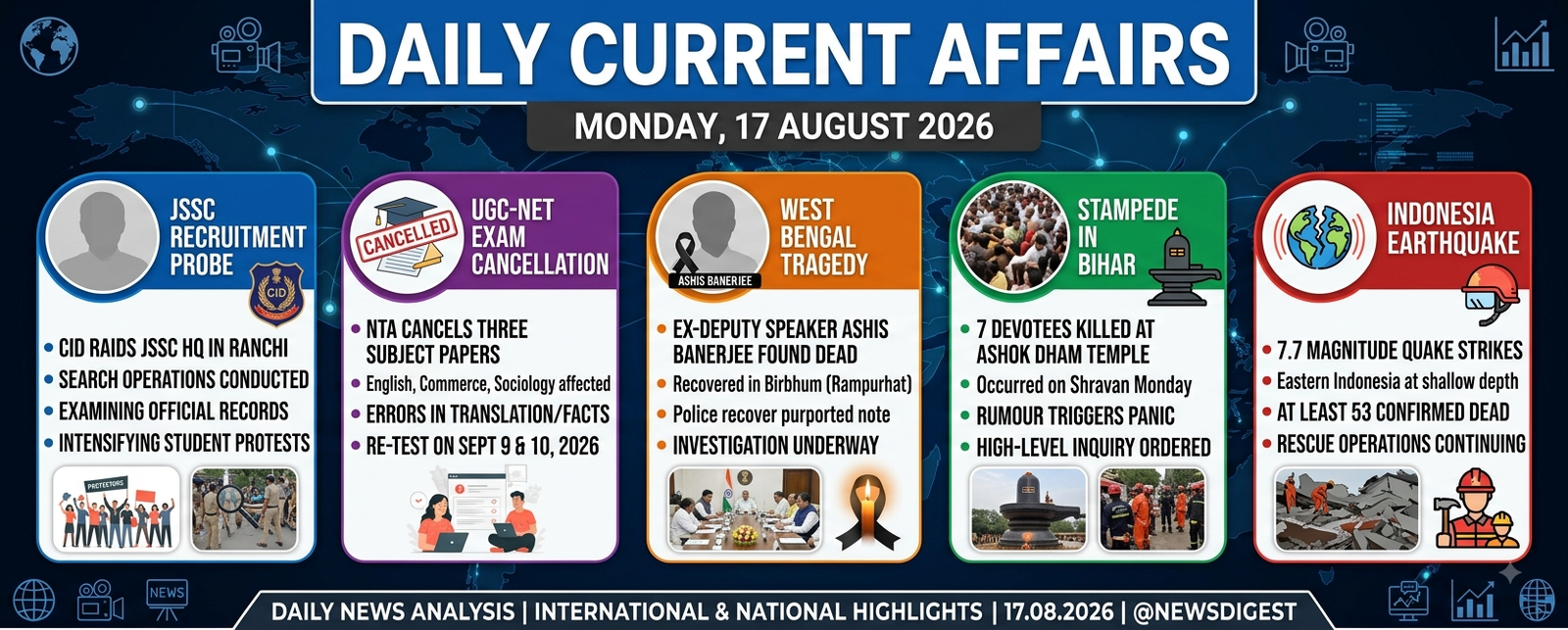
The agitation by Jharkhand's government-job aspirants has entered its 25th day, intensifying the pressure on the State administration over alleged irregularities in competitive examinations. After prolonged demonstrations and negotiations, Chief Minister Hemant Soren announced the cancellation of the Jharkhand Staff Selection Commission Combined Graduate Level (JSSCCGL) examination, which had been conducted with the assistance of an outsourced agency. The cancellation represents a major concession to protesting candidates, who have repeatedly questioned the credibility and security of the recruitment process. The decision also raises concerns about the consequences for thousands of aspirants who had invested considerable time and resources preparing for the examination.
Following the Government's announcement, some student leaders called off their hunger strikes, viewing the cancellation as an initial victory. However, the JPSC-JSSC Reform Manch has announced a second phase of its agitation, indicating that the movement will continue until its wider demands are addressed. Student representatives are particularly demanding a CBI investigation into alleged paper-leak networks and recruitment irregularities extending beyond the cancelled examination. They argue that merely cancelling examinations does not establish accountability or prevent similar incidents from recurring.
The continuing agitation highlights broader concerns about transparency and institutional accountability in Jharkhand's public recruitment system. Students have demanded stronger examination-security mechanisms, predictable recruitment calendars, independent investigations and action against officials or private agencies found responsible for irregularities. A CBI inquiry, if ordered, could examine whether organised syndicates were involved, identify the source of leaked material, trace financial transactions and determine the responsibility of officials or intermediaries. The Government must now balance the need for a credible investigation with the practical challenge of conducting fresh examinations without further delays. The episode underscores the importance of maintaining public confidence in recruitment institutions, particularly when examination outcomes determine access to government employment and thousands of young candidates' professional futures.
4. ISRO prepares to resume launches with GISAT-1A Earth-observation mission
Keywords: ISRO, GISAT-1A, Earth Observation
The Indian Space Research Organisation (ISRO) is preparing to resume a major orbital-launch programme with the proposed GISAT-1A (EOS-05) Earth-observation satellite, currently targeted for launch in September 2026 aboard the GSLV Mk II from the Satish Dhawan Space Centre. The mission is particularly significant because ISRO's launch schedule has faced interruptions following technical issues in earlier missions. Government disclosures have indicated that technical reasons led to deferments and that expert review mechanisms were put in place to examine launch-vehicle anomalies and recommend corrective measures. The return of a GSLV mission therefore represents an important step in restoring the regularity and confidence of India's launch programme.
GISAT-1A is designed as a geostationary Earth-observation satellite, intended to provide continuous imaging of the Indian subcontinent. Its capabilities are expected to support applications including weather observation, environmental monitoring, disaster management and rapid assessment of natural hazards. By operating from a geostationary orbit, the satellite can repeatedly observe the same geographical region, allowing authorities to monitor developing events more quickly than conventional low-Earth-orbit observation systems. The mission will also demonstrate the continuing importance of India's indigenous GSLV platform for placing heavier satellites into geostationary transfer orbit
The planned mission carries wider strategic significance for India's space programme. Reliable access to orbit is essential for national capabilities in weather forecasting, disaster response, communications, agriculture and environmental surveillance. It also demonstrates ISRO's effort to strengthen launch reliability while progressing towards a busy pipeline of scientific, Earth-observation and human-spaceflight missions. The September target remains subject to final technical readiness and scheduling decisions, and an exact launch date has yet to be firmly confirmed. Nevertheless, GISAT-1A's anticipated launch represents an important opportunity for ISRO to re-establish momentum in its orbital programme and strengthen the country's domestic space infrastructure.
5. Strait of Hormuz crisis deepens after commercial vessel hit near Oman
Keywords: Strait of Hormuz, Maritime Security, Iran, Commercial Shipping.
Tensions in the Strait of Hormuz have intensified after the UK Maritime Trade Operations (UKMTO) reported that a commercial vessel was struck by an unidentified projectile while travelling outbound through the strategically important waterway near the coast of Oman. The incident reportedly caused damage to the vessel's engine room and resulted in casualties among the crew, raising renewed concerns about the safety of international commercial shipping in the Gulf. Maritime authorities are investigating the nature and origin of the projectile, while shipping operators are closely monitoring the security situation and reassessing navigation routes through the region.
The incident comes amid an increasingly confrontational dispute over the status of the Strait. Iranian chief negotiator Mohammad Baqer Qalibaf has stated that the waterway will remain closed until the United States lifts its maritime blockade and releases frozen Iranian assets. Tehran's position places the reopening of one of the world's most important energy corridors directly within wider diplomatic negotiations involving sanctions, maritime restrictions and financial assets. Any prolonged closure could have major consequences because the Strait is a principal route for global oil and liquefied natural gas shipments.
The latest vessel incident has therefore raised concerns well beyond immediate maritime security. Prolonged disruption could increase shipping insurance premiums, freight costs and global energy prices, while forcing tankers and cargo vessels to seek longer alternative routes. It could also increase the risk of further confrontation between Iran, the United States and regional actors. The situation highlights the vulnerability of civilian shipping to geopolitical conflicts and the importance of maintaining secure navigation corridors under international maritime law. Diplomatic efforts to reopen the Strait will be closely watched, as restoring freedom of commercial navigation is essential not only to regional stability but also to the global energy and supply-chain system.