⚖️ LEGAL NEWS | 14.08.2026
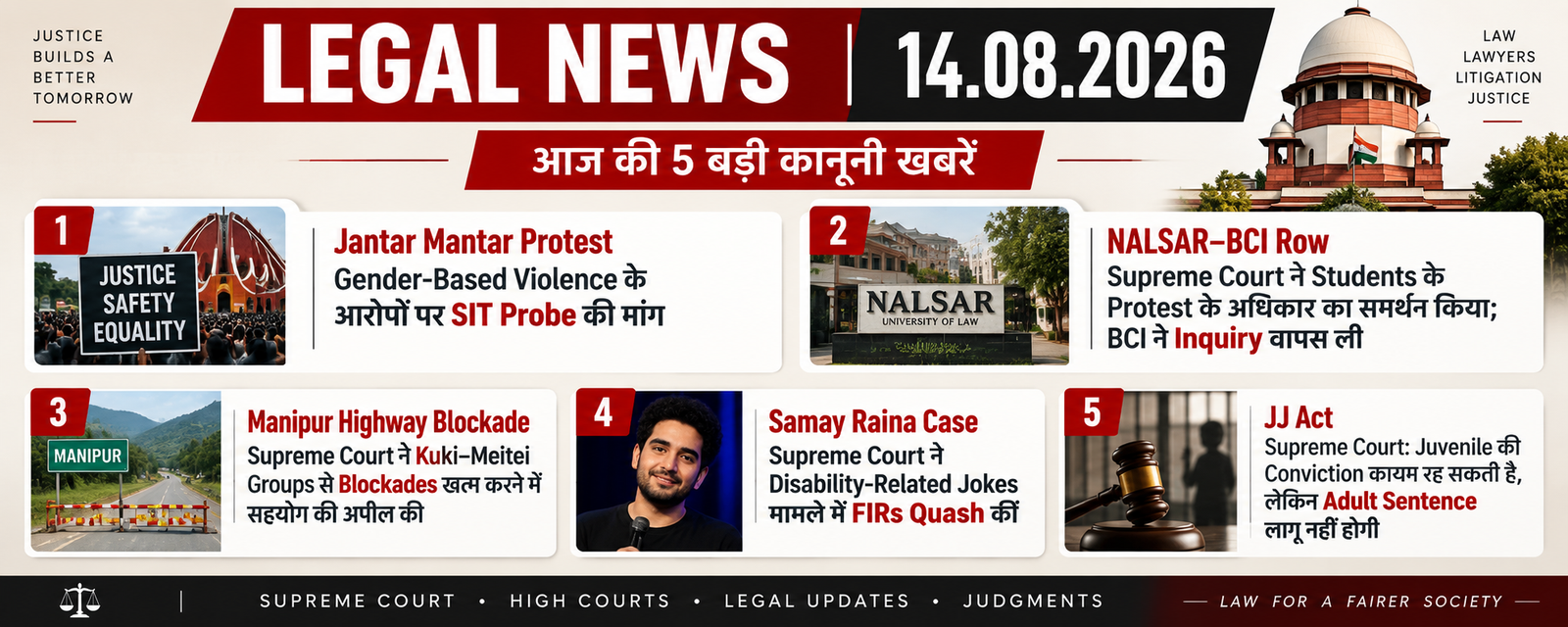
1. Jantar Mantar protest: Plea seeks SIT probe into alleged gender-based violence by police
Keywords: Jantar Mantar, SIT Probe, Gender-Based Violence
A petition before the Supreme Court has sought an independent Special Investigation Team (SIT) probe into allegations of excessive police force, arbitrary detention and gender-based violence allegedly committed against protesters during the Jantar Mantar student demonstrations. The plea specifically raises allegations concerning the conduct of police personnel and vigilantes towards women protesters and seeks accountability for those allegedly responsible. The petitioners contend that an impartial investigation is necessary because the allegations involve law-enforcement personnel themselves, creating concerns about the credibility and independence of an ordinary departmental inquiry
The petition seeks the constitution of an SIT or judicial commission headed by a retired Supreme Court judge to investigate the alleged incidents. It also seeks identification of police personnel deployed during the protest, registration of appropriate FIRs where cognisable offences are disclosed, preservation of CCTV footage and protest-related videos, and action against officers allegedly involved in assaults or sexual misconduct. The plea further calls for nationwide safeguards governing crowd-control operations, including restrictions on the use of unidentified or plain-clothes personnel and stronger accountability mechanisms during demonstrations. The allegations arise from the July 20 protests, during which protesters and police personnel gave competing accounts of the violence and injuries.
The matter raises important constitutional questions concerning the intersection of Articles 19 and 21, which protect peaceful assembly, expression, life and personal liberty, with the State's responsibility to maintain public order. The Court's consideration of an independent investigation could have wider implications for police accountability during protests, particularly where allegations involve sexual or gender-based misconduct. It may also reinforce the principle that legitimate crowd-control objectives cannot justify disproportionate or unlawful treatment of demonstrators. At the same time, any investigation would have to examine allegations against both protesters and security personnel objectively, ensuring that accountability applies irrespective of institutional or political affiliation. The proceedings therefore have significance beyond the Jantar Mantar incident, potentially shaping future standards for gender-sensitive policing, protest management and independent investigation of alleged police excesses.
2. NALSAR-BCI row: Supreme Court backs students' right to protest, BCI withdraws inquiry
Keywords: NALSAR Students, Bar Council of India, Right to Protest
A controversy between the Bar Council of India (BCI) and students of the 2026 graduating batch of NALSAR University of Law, Hyderabad has escalated into a significant debate over student dissent and the limits of regulatory authority. The controversy began after NALSAR students protested against the invitation extended to Chief Justice of India Surya Kant as chief guest for the university's convocation. In response, the BCI initially directed State Bar Councils not to enrol the entire 2026 graduating batch as advocates. The sweeping measure triggered strong criticism from students, lawyers and sections of the legal fraternity, following which the BCI withdrew the blanket restriction and subsequently dropped its proposed inquiry.
The episode nevertheless reached the Supreme Court, where a plea sought an examination of the circumstances in which the BCI Chairman had issued directions affecting the students' professional careers. During the hearing, CJI Surya Kant strongly disapproved of the BCI's intervention, observing that students have a legitimate right to express disagreement and protest. The Court questioned the basis for imposing consequences on an entire graduating batch when the alleged conduct concerned only some students. The judicial observations underline that participation in peaceful protest cannot automatically become a ground for jeopardising a student's future enrolment as an advocate. The controversy also raises questions about whether a professional regulatory body can impose collective consequences on students of an educational institution without clear statutory authority and individual determination of wrongdoing.
The matter carries wider significance for academic freedom, freedom of expression and professional regulation. Universities are important spaces for debate, dissent and political expression, while the BCI's regulatory powers primarily concern standards of legal education and professional practice. The Supreme Court's intervention therefore reinforces the principle that disciplinary or regulatory action must have a lawful basis, follow due process, and remain proportionate to individual conduct. The episode also demonstrates the constitutional importance of protecting young lawyers' ability to participate in democratic debate without fear that peaceful disagreement will permanently affect their professional prospects.
3. Supreme Court urges Kuki, Meitei groups to help end Manipur highway blockades
Keywords: Manipur Violence, Highway Blockades, Peace Process.
Case Name: Kuki Women Organisation for Human Rights, A Wing of Kuki Organisation of Human Rights Trust (Kahur) and Anr. v. The State of Manipur and Anr. [W.P. (C) No. 961/2026]
The Supreme Court has urged organisations representing the Kuki and Meitei communities to move towards peace and submit concrete proposals for removing blockades from national highways across Manipur. The direction came while hearing a Public Interest Litigation seeking the removal of a blockade on National Highway 2 and restoration of the supply of essential commodities to affected areas. A Bench headed by Chief Justice of India Surya Kant, along with Justices Joymalya Bagchi and V. Mohana, stressed that the matter should not be approached as adversarial litigation and appealed to the parties to "think of peace now". The Court also impleaded the National Highways Authority of India (NHAI) and sought information regarding other blocked highways.
During the hearing, the petitioner argued that the continuing blockades had severely affected the availability of food, essential commodities and access to education in affected districts. The Chief Justice acknowledged the seriousness of the situation but cautioned that sweeping judicial directions could potentially trigger further violence if implemented without adequate coordination. The Court observed that highways are the lifeline of ordinary citizens and questioned why either community should benefit from their continued closure. Justice Bagchi further indicated that the issue should be addressed across Manipur rather than through isolated orders concerning individual highways. He also noted the absence of representation from Naga groups, suggesting that their position would need to be considered.
The proceedings represent an attempt by the Supreme Court to combine humanitarian concerns with conflict-sensitive judicial intervention. Rather than immediately ordering enforcement action that could aggravate tensions, the Court has sought cooperation from the competing groups and encouraged a negotiated mechanism for restoring highway connectivity. The case highlights the wider constitutional importance of maintaining access to food, healthcare, education and other essential services during prolonged internal conflict, while ensuring that efforts to restore public infrastructure do not themselves create additional risks to civilian life and security.
4. Supreme Court quashes FIRs against Samay Raina and others over disability-related jokes
Keywords: Samay Raina, Disability Rights, Free Speech.
Case Name: M/S Cure SMA Foundation of India v. Union of India and Ors. [W.P. (C) No. 460/2025]
The Supreme Court has quashed the FIRs and criminal proceedings against comedian Samay Raina and four other performers arising from insensitive remarks about persons with disabilities. The proceedings stemmed from the controversy surrounding the digital comedy show India's Got Latent, where jokes concerning disability and people suffering from serious medical conditions triggered widespread criticism and multiple police complaints. The Court, while recognising the problematic nature of the remarks, ultimately decided to bring the criminal proceedings to an end, taking into account the subsequent steps taken by the performers to address the concerns raised. The decision provides relief to the accused while closing a contentious episode that had raised important questions about the boundaries of online comedy and free expression.
The Court had previously required the performers to take corrective measures, including issuing apologies and using their platforms to raise awareness about persons with disabilities and support causes concerning rare diseases. During the proceedings, the Court had also imposed ₹3 lakh costs each after finding that undertakings given to the Court had not been fully complied with. The latest order, however, reflects the Court's recognition of the efforts subsequently undertaken to make amends and promote awareness concerning disability rights. The proceedings therefore evolved from merely determining criminal liability to encouraging corrective and socially responsible conduct.
The case highlights the delicate constitutional balance between freedom of speech and expression under Article 19(1)(a) and the right to dignity protected under Article 21. While comedy and satire enjoy constitutional protection, expression that humiliates or dehumanises vulnerable communities can raise legitimate concerns about dignity and equality. By quashing the FIRs while acknowledging the importance of corrective action, the Supreme Court has signalled that criminal prosecution should not necessarily be the sole response to every instance of offensive expression. The ruling may influence future approaches to online speech, satire, disability rights and the proportionality of criminal law in cases involving controversial digital content.
5. JJ Act: Supreme Court says juvenile's conviction may stand, but adult sentence cannot be enforced
Keywords: Juvenile Justice Act, Juvenile As Adult, Section 15
Case Name: Dinesh Kumar v. The State of Haryana [2026 LiveLaw (SC) 805]
The Supreme Court has clarified an important aspect of the Juvenile Justice (Care and Protection of Children) Act, 2015, holding that a conviction is not automatically invalid merely because a juvenile was tried by a regular criminal court as an adult. However, the Court made it clear that a sentence imposed under the ordinary criminal justice system cannot operate against a person who was a child in conflict with law, unless the statutory procedure under the JJ Act for transferring and trying the juvenile as an adult has been properly followed. The judgment distinguishes between the validity of the finding of guilt and the legality of the punishment imposed.
The case concerned an accused who was a juvenile at the time of the alleged offence but was subsequently tried by a regular court. The Supreme Court examined the relationship between Section 15, which requires a Juvenile Justice Board to conduct a preliminary assessment in cases involving children aged 16–18 accused of heinous offences, and Section 19, which governs the Children's Court's role after such assessment. The Court emphasised that treating a child as an adult is not automatic merely because the offence is classified as heinous. The prescribed statutory process must be followed before jurisdiction can shift from the juvenile justice framework.
The ruling reinforces the child-centric and rehabilitative philosophy underlying the JJ Act. While the Court did not necessarily erase the finding of guilt solely because the juvenile was tried by a regular court, it held that an adult sentence cannot be permitted to operate contrary to the protections provided by juvenile justice law. The appropriate authorities must therefore reconsider the consequences in accordance with the JJ Act. The judgment is significant because it balances the interests of criminal accountability with the statutory recognition that children possess a greater capacity for rehabilitation and reform.