Supreme Court & High Courts की 6 बड़ी खबरें | Legal News
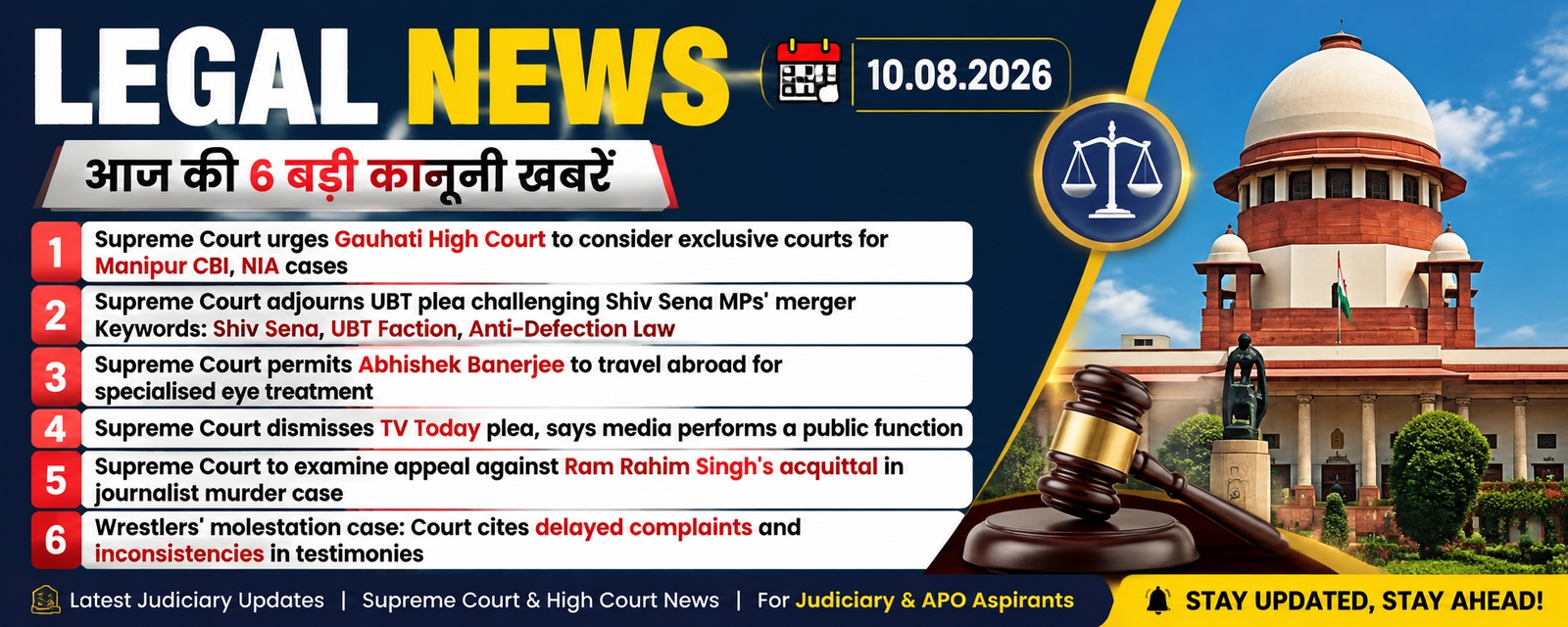
1. Supreme Court urges Gauhati High Court to consider exclusive courts for Manipur CBI, NIA cases
Keywords: Manipur Violence, CBI, NIA
Case Name: Central Bureau of Investigation v. Arun Khundongbam @Nanao [SLP (Crl.) No. 5756/2026 (and connected cases)]
The Supreme Court has urged the Chief Justice of the Gauhati High Court to consider establishing exclusive courts for cases investigated by the Central Bureau of Investigation (CBI) and National Investigation Agency (NIA) arising from the ongoing violence in Manipur. The suggestion is aimed at ensuring faster and more effective adjudication of cases emerging from the prolonged conflict.
The Court's observation assumes significance because the Manipur violence has generated a large number of criminal cases involving serious allegations, including killings, sexual violence, arson, destruction of property, and offences affecting public order and national security. Several matters have been entrusted to central investigating agencies, making efficient coordination between investigation and prosecution particularly important. The Supreme Court indicated that dedicated judicial mechanisms could help prevent delays caused by the regular workload of existing courts. Exclusive courts dealing with CBI and NIA cases could provide focused judicial attention, facilitate systematic scheduling of trials, and enable cases arising from the violence to progress in a more structured manner.
The proposal also reflects the judiciary's concern about ensuring access to justice for victims in a conflict-affected region. Prolonged trials can deepen uncertainty for victims, witnesses, and accused persons alike. Dedicated courts, if constituted, could potentially improve case management while reducing the possibility of sensitive matters remaining pending for extended periods. At the same time, the establishment of special courts would require adequate judicial infrastructure, prosecutors, court staff, security arrangements, and witness-protection mechanisms. Given the sensitive nature of cases arising from communal and ethnic violence, protecting witnesses and ensuring a fair trial will remain essential. The Supreme Court's suggestion does not itself establish such courts but places the matter before the Gauhati High Court's Chief Justice for consideration. If implemented, the measure could become an important institutional response to the enormous judicial burden created by the Manipur conflict. The development highlights the Supreme Court's continuing emphasis on speedy trials, institutional efficiency, and meaningful access to justice in cases arising from prolonged internal conflict.
2. Supreme Court adjourns UBT plea challenging Shiv Sena MPs' merger
Keywords: Shiv Sena, UBT Faction, Anti-Defection Law
Case Name: Arvind Ganpat Sawant v. Hon’ble Speaker, Lok Sabha and Ors. [W.P. (C) No. 886/2026]
The Supreme Court has adjourned the hearing of a plea filed by the Uddhav Balasaheb Thackeray (UBT) faction of Shiv Sena challenging the merger of its rival group of Members of Parliament with the Shiv Sena faction led by Maharashtra Chief Minister Eknath Shinde. The proceedings were adjourned after the concerned Lok Sabha Speaker did not appear before the Court. The dispute forms part of the larger constitutional and political controversy arising from the split in Shiv Sena. The UBT faction has challenged the manner in which the rival MPs were recognised and their subsequent merger, raising questions concerning the Tenth Schedule of the Constitution, parliamentary party recognition, and the powers of the Speaker in matters involving defections and mergers.
The petition assumes significance because the anti-defection framework seeks to prevent elected representatives from changing political allegiance in circumstances that undermine the mandate received from voters. At the same time, the Tenth Schedule contains provisions concerning mergers, making the interpretation of these provisions particularly important in cases involving rival claims over a political party. The Supreme Court's decision to adjourn the matter means that the substantive issues remain unresolved. The Court is expected to examine the legal basis on which the MPs' merger was recognised and whether the constitutional requirements governing a valid political merger were satisfied.
The proceedings are also connected with the broader question of the relationship between a political party and its legislative wing, an issue that has repeatedly surfaced during the Shiv Sena dispute. The Supreme Court has previously emphasised the importance of examining party organisation and legislative conduct while interpreting the anti-defection framework. The case could have wider implications for parliamentary democracy, party splits, defections, and the constitutional responsibilities of the Speaker. A final ruling may provide important guidance on how mergers involving parliamentary parties should be assessed under the Tenth Schedule.
3. Supreme Court permits Abhishek Banerjee to travel abroad for specialised eye treatment
Keywords: Abhishek Banerjee, Medical Treatment, Personal Liberty
Case Name: Abhishek Banerjee v. State of West Bengal [SLP (Crl.) 14489/2026
The Supreme Court has granted Trinamool Congress MP Abhishek Banerjee permission to travel abroad for specialised eye treatment, observing that an individual has the right to choose appropriate medical care. The decision came after Banerjee approached the Court seeking permission for overseas treatment despite restrictions imposed on his foreign travel in connection with an ongoing investigation. Banerjee had previously approached the Court seeking permission to travel abroad for medical treatment after the Calcutta High Court had imposed conditions restricting his international travel. His request was considered in the context of his medical needs as well as the investigating agency's concerns regarding his availability during the investigation.
While granting permission, the Supreme Court emphasised the importance of personal liberty and individual autonomy in healthcare decisions. The Bench observed that a person cannot ordinarily be prevented from choosing the medical facility or specialist they consider appropriate merely because legal proceedings are pending against them. At the same time, the Court balanced this right with the requirements of the ongoing investigation by imposing appropriate safeguards on the foreign travel. The permission is reportedly subject to conditions intended to ensure that Banerjee remains available to the investigating authorities and complies with the requirements of the proceedings. Such conditions may include providing travel details, maintaining communication with the investigating agency, and returning to India within the stipulated period.
The ruling is significant because it demonstrates how courts balance Article 21 protections with the legitimate requirements of criminal investigations. The right to life and personal liberty encompasses important aspects of individual autonomy, including access to appropriate healthcare, although such rights may be regulated through lawful and proportionate restrictions. The Court's observation also reinforces the principle that being an accused or a person under investigation does not automatically extinguish one's fundamental rights. Restrictions on liberty must have a legitimate legal basis and must remain proportionate to the circumstances. The decision therefore represents an important intersection of medical autonomy, personal liberty, and criminal procedure, while allowing the investigation against Banerjee to continue in accordance with law.
4. Supreme Court dismisses TV Today plea, says media performs a public function
Keywords: TV Today Network, Media Accountability, Public Function
Case Name: TV Today Network Limited v. ABC and Ors. [SLP (C) No. 27299/2026]
The Supreme Court has dismissed a plea filed by TV Today Network challenging a penalty imposed by the Delhi High Court, while making significant observations regarding the public role and responsibilities of the media. During the proceedings, the Court rejected the contention that a media organisation could claim that it does not perform a public function merely because it is a private entity. The case arose from proceedings before the Delhi High Court in which the broadcaster had been subjected to a monetary penalty. TV Today challenged the order before the Supreme Court, questioning the legal basis for the penalty and the applicability of the obligations imposed upon it. While dealing with the appeal, the Supreme Court emphasised that the media occupies a distinctive position in a democratic society. Television news organisations exercise considerable influence over public opinion, political discourse, and the dissemination of information. Consequently, their activities cannot always be viewed exclusively through the lens of private commercial operations.
The Court's observation that the media performs a public function is significant in the context of constitutional accountability. Freedom of speech and expression under Article 19(1)(a) provides strong protection to journalistic activity, but that freedom is accompanied by responsibilities relating to accuracy, fairness, and compliance with applicable law. The judgment also highlights the broader tension between media freedom and institutional accountability. Courts must protect legitimate journalistic independence while ensuring that media organisations do not use their private status to evade lawful obligations or judicial directions.
By dismissing TV Today's challenge, the Supreme Court has allowed the Delhi High Court's order to stand. The ruling may have wider implications for broadcasters and other media organisations, particularly where their conduct has consequences extending beyond private commercial interests. The decision reinforces the principle that institutions exercising substantial influence over public discourse may carry responsibilities corresponding to their wider societal impact. It therefore represents an important development in the continuing debate over media accountability, freedom of expression, and the public responsibilities of private broadcasters.
5. Supreme Court to examine appeal against Ram Rahim Singh's acquittal in journalist murder case
Keywords: Ram Rahim Singh, Ram Chander Chhatrapati, Appeal Against Acquittal.
Case Name: Aridman v. Baba Gurmeet Singh @ Maharaj Gurmeet Singh @ Gurmeet Ram Rahim Singh and Anr. [Diary No. 40480-2026]
The Supreme Court has agreed to hear an appeal challenging the acquittal of Gurmeet Ram Rahim Singh and another accused in the murder case of journalist Ram Chander Chhatrapati. The appeal has been filed by the slain journalist's son, who has questioned the correctness of the acquittal and sought renewed judicial scrutiny of the evidence and findings recorded by the lower court. The case relates to the 2002 killing of journalist Ram Chander Chhatrapati, who had published reports concerning allegations of sexual exploitation and other misconduct associated with the Dera Sacha Sauda organisation. His murder subsequently became one of the major criminal cases connected with the organisation and its former chief.
Ram Rahim was convicted in the murder case by a special CBI court in 2019 and sentenced to life imprisonment. The conviction was later challenged before the Punjab and Haryana High Court, which acquitted him and another accused. The journalist's son has now approached the Supreme Court against that decision. While considering the matter, the Supreme Court indicated that the challenge to the acquittal requires judicial consideration. The Court's decision to entertain the appeal does not amount to a finding that the accused is guilty; rather, it means that the Court will examine whether the High Court correctly appreciated the evidence and applied the relevant legal principles while overturning the conviction.
Appeals against acquittal require courts to exercise particular caution because an accused who has been acquitted enjoys the presumption of innocence, which is strengthened by the acquittal itself. At the same time, appellate courts can interfere where an acquittal is found to be legally unsustainable or based upon a serious misappreciation of evidence. The case therefore raises important questions concerning appellate review of acquittals, evidentiary appreciation, and the rights of victims' families to seek justice. The Supreme Court's eventual ruling could determine whether the acquittal should stand or whether the matter requires further judicial reconsideration.
6. Wrestlers' molestation case: Court cites delayed complaints and inconsistencies in testimonies
Keywords: Brij Bhushan Sharan Singh, Wrestlers' Case, Sexual Harassment
In a significant development in the sexual-harassment case involving former Wrestling Federation of India (WFI) chief Brij Bhushan Sharan Singh, the court, while examining the prosecution evidence, highlighted alleged inconsistencies in the testimonies of the complainants and the delay in reporting the alleged incidents. The court noted that some complainants had not immediately approached the authorities regarding the allegations and had continued to maintain what the defence described as cordial or professional relations with Singh. These circumstances were considered while assessing the overall credibility and consistency of the prosecution's case. The observations form part of the court's evaluation of the evidence and do not, by themselves, establish that an allegation of sexual harassment is false merely because it was reported after a delay.
The case concerns allegations made by several women wrestlers against Singh, who was accused of sexual harassment, assault and stalking. The allegations triggered a prolonged public protest by prominent wrestlers, including Sakshi Malik, Vinesh Phogat and Bajrang Punia, and generated a nationwide debate over accountability within sporting institutions. The court's assessment also focused on variations between different statements and versions provided during the proceedings. In criminal trials, particularly cases involving sexual offences, courts are required to carefully examine whether inconsistencies are material enough to affect the reliability of the prosecution evidence.
At the same time, the mere existence of a delay in reporting sexual misconduct is not automatically fatal to a prosecution. Victims may delay reporting because of fear, social pressure, professional consequences, power asymmetry or other personal circumstances. The legal question is whether the overall evidence, viewed in its entirety, establishes the allegations beyond reasonable doubt. The proceedings therefore highlight the delicate judicial balance between protecting survivors of sexual offences and ensuring the accused receives a fair trial. The court's observations underline the importance of credible, consistent and legally admissible evidence when determining criminal liability.