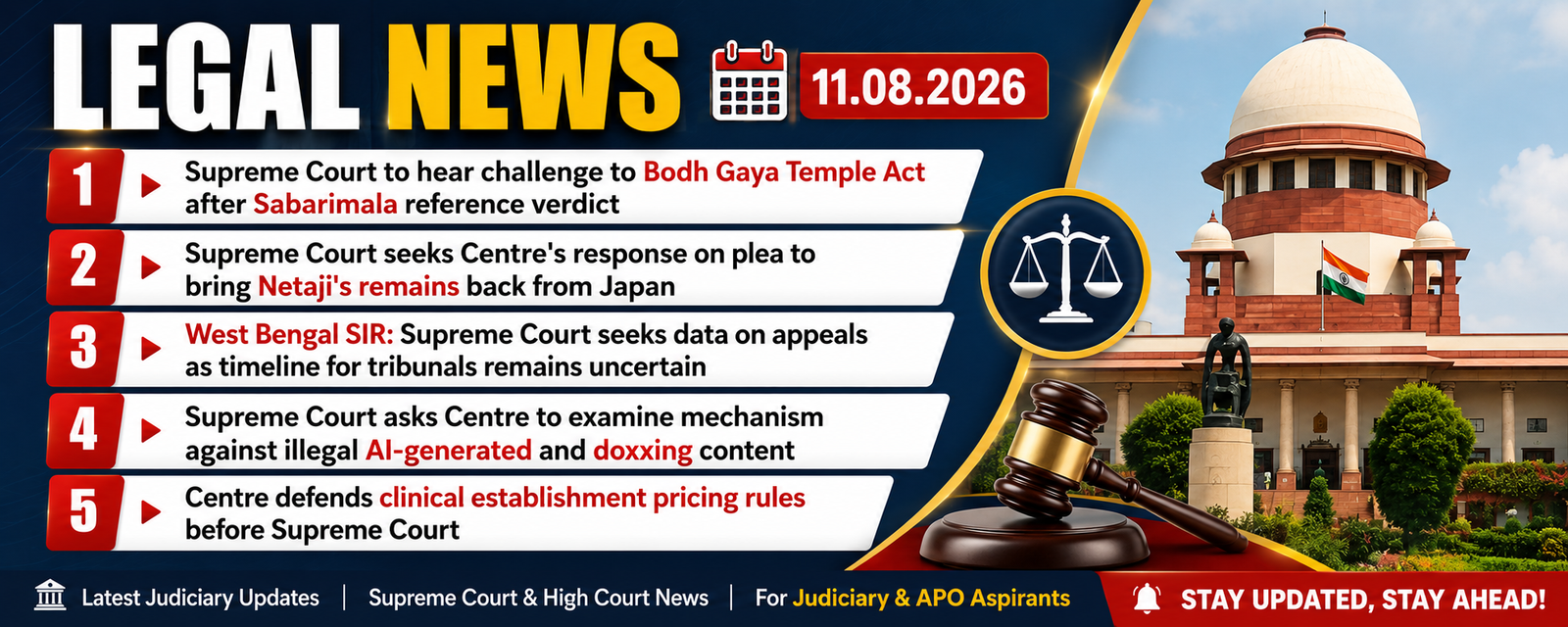
Legal News | 11 August 2026 | Supreme Court की 5 बड़ी खबरें
1. Supreme Court to hear challenge to Bodh Gaya Temple Act after Sabarimala reference verdict
Keywords: Bodh Gaya Temple Act, Sabarimala Reference, Religious Freedom
Case Name: Bhante Arya Nagarjun Shurai Sasai and Anr. Union of India and Ors.
The Supreme Court is set to hear a challenge to the Bodh Gaya Temple Act, 1949, after the Constitution Bench's recent decision concerning the legal questions arising from the Sabarimala reference. The matter has been listed for hearing in October and could raise important constitutional questions concerning the management of religious institutions and the relationship between religious freedom and statutory regulation. The Bodh Gaya Temple Act provides for the management and administration of the Mahabodhi Temple at Bodh Gaya, one of the most important Buddhist pilgrimage sites in the world. The legislation created a statutory management committee with representation from both Buddhist and Hindu communities. Its constitutional validity and the nature of rights associated with the management of the temple have been contested before the courts.
The
challenge assumes greater significance following the Supreme Court's
consideration of the broader principles governing religious practices,
denominational rights and the authority of the State to regulate religious
institutions. The Sabarimala reference proceedings required the Court to
examine questions concerning the scope of judicial review of religious
practices and the interpretation of constitutional protections relating to
religion. The upcoming hearing could therefore provide an opportunity for the
Court to examine whether statutory intervention in the administration of a
religious or sacred institution violates protections under Articles 25 and 26
of the Constitution. It may also require the Court to distinguish between
matters of religious belief and secular aspects of temple administration, which
can be subject to regulation by law.
The case is particularly significant because the Mahabodhi Temple has immense historical, religious and cultural importance for Buddhists globally. Any ruling concerning its statutory management could have implications beyond the immediate dispute and contribute to the evolving constitutional jurisprudence on religious freedom, institutional autonomy and State regulation of religious institutions. The Supreme Court's eventual determination will therefore be closely watched for its implications for the balance between constitutional guarantees of religious freedom and legislative authority over the administration of religious places.
2. Supreme Court seeks Centre's response on plea to bring Netaji's remains back from Japan
Keywords: Netaji Subhas Chandra Bose, Anita Bose Pfaff, Repatriation of Remains.
Keywords: Netaji Subhas Chandra Bose, Anita Bose Pfaff, Repatriation of Remains.
The Supreme Court has issued notice on a petition filed by Anita Bose Pfaff, daughter of freedom fighter Netaji Subhas Chandra Bose, seeking the repatriation of his mortal remains from Japan to India. The matter was heard by a Bench comprising Chief Justice of India Surya Kant, Justice Joymalya Bagchi and Justice V. Mohana.
The petition concerns the ashes and urn preserved at Renko-ji Temple in Tokyo, which have long been associated with Netaji following the reported circumstances of his death in 1945. The question of the authenticity and final disposition of these remains has remained a matter of historical and public debate in India for decades. Anita Pfaff has sought several directions from the Court. These include requiring the Government to initiate formal communication through the Ministry of External Affairs to ensure preservation of the ashes and maintenance of the status quo at Renko-ji Temple. She has also sought the constitution of an Inter-Ministerial Committee and a concrete action plan for bringing the remains back to India.
The present petition assumes particular significance because the Supreme Court had earlier declined to entertain a similar petition filed by Netaji's grandnephew, Ashis Ray, noting that Anita Pfaff, described as Netaji's sole heir, was not the petitioner. The present proceedings therefore directly place the family's request before the Court. The case involves an unusual intersection of constitutional litigation, diplomatic relations, historical legacy and family rights. Any repatriation would necessarily require coordination between India and Japan and consideration of the status of the remains held at the Tokyo temple. The Court's issuance of notice does not mean that repatriation has been ordered. The Centre will now have an opportunity to respond to the petition and explain its position regarding the preservation and possible return of Netaji's remains.
3.
West
Bengal SIR: Supreme Court seeks data on appeals as timeline for tribunals
remains uncertain
Keywords:
West Bengal SIR, Electoral Rolls, Appellate Tribunals
Case Name: Adhir Ranjan Chowdhury v. Election Commission of India [D. No. 38345/2026]
The
Supreme Court, while hearing challenges relating to the Special Intensive
Revision (SIR) of electoral rolls in West Bengal, has declined to prescribe a
fixed timeline for the functioning of appellate tribunals that will hear
objections and appeals arising from the exercise. The Court instead sought
detailed data concerning the number of appeals received and disposed of by
these tribunals.
The
SIR exercise involves verification and revision of electoral rolls, making the
process particularly significant for determining the eligibility and inclusion
of voters. Concerns have been raised over the manner in which objections are
handled and whether affected individuals will receive adequate opportunities to
challenge decisions concerning their inclusion in electoral lists. During the
proceedings, the Supreme Court indicated that it would be difficult to
determine a uniform deadline for appellate tribunals without first
understanding their existing workload and disposal capacity. The Court
therefore sought information on the number of appeals filed, pending matters,
and cases already decided. Such data would allow the Court to assess whether
the existing mechanism is capable of dealing with the volume of challenges
within the electoral process.
The issue is significant because electoral-roll revision must balance two competing objectives: preventing ineligible persons from remaining on electoral rolls while ensuring that genuine voters are not arbitrarily excluded. Any delay in deciding appeals could create uncertainty for citizens whose names have been removed or whose eligibility has been questioned. The Court's approach reflects the principle that judicial directions concerning administrative timelines should be based on practical realities and institutional capacity rather than arbitrary deadlines. At the same time, effective appellate mechanisms are essential to ensuring procedural fairness and access to remedies. The proceedings could have wider implications for the conduct of electoral-roll revisions, particularly where large-scale verification exercises generate substantial numbers of objections and appeals. The Supreme Court's eventual directions may seek to establish a balance between administrative efficiency, electoral integrity, and protection of citizens' voting rights. The case therefore remains important not only for West Bengal's electoral rolls but also for the broader constitutional principle that electoral administration must remain transparent, fair and subject to meaningful procedural safeguards.
4.
Supreme
Court asks Centre to examine mechanism against illegal AI-generated and doxxing
content
Keywords:
Artificial Intelligence, Doxxing, Digital Regulation
Case
Name: Narendra Kumar Goswami v. Union of India and Ors. [W.P. (C) No. 823/2026]
The
Supreme Court has directed the Union Government to consider a representation
seeking an effective mechanism to prevent and address illegal content generated
or manipulated using artificial intelligence (AI), as well as content involving
doxxing and the unauthorised disclosure of personal information. The
development highlights the judiciary's growing concern over emerging forms of
digital harm and the challenges they create for existing legal and regulatory
frameworks.
The
plea reportedly draws attention to the increasing misuse of AI tools for
creating manipulated photographs, videos, audio recordings and other forms of
synthetic content. Such material can be used for impersonation, harassment,
fraud, reputational attacks and the dissemination of misleading information.
Doxxing, meanwhile, involves publishing an individual's private or identifying
information without consent, potentially exposing victims to harassment,
threats and other forms of harm. The Supreme Court's direction does not itself
create a new legal framework or impose a blanket prohibition on AI-generated
material. Instead, the Court has asked the Union to examine the concerns raised
and consider whether an appropriate regulatory or technological mechanism can
be developed to deal with unlawful content.
The matter raises important constitutional and policy questions. Any regulatory mechanism would have to protect individuals from genuine digital abuse while simultaneously safeguarding freedom of speech and expression under Article 19(1)(a). Overbroad restrictions could potentially affect legitimate uses of AI, including satire, journalism, artistic expression, research and political commentary. The issue also highlights the difficulty of regulating rapidly evolving technologies through conventional legal mechanisms. Effective enforcement may require cooperation among government authorities, social-media platforms, technology companies, law-enforcement agencies and digital-forensics experts. A comprehensive framework could potentially address rapid reporting and takedown procedures, preservation of digital evidence, victim grievance mechanisms, platform accountability, and identification of malicious synthetic content. The Supreme Court's intervention therefore underscores the need for India to develop clear, proportionate and technologically adaptable safeguards against digital harms while maintaining constitutional protections for legitimate online expression.
5.
Centre
defends clinical establishment pricing rules before Supreme Court
Keywords: Clinical Establishments Act, Healthcare Regulation,
Medical Pricing
Case
Name: All India Ophthalmological Society v. Union of India [W.P. (C) No.
214/2024]
The
Union Government has defended the Clinical Establishments (Registration and
Regulation) Act, 2010 and the rules framed under it before the Supreme Court,
arguing that regulatory provisions concerning medical charges are necessary to
prevent excessive and unreasonable pricing of healthcare services.
The
matter concerns provisions requiring clinical establishments to follow notified
standards and display or disclose information relating to medical services and
charges. The Centre has maintained that such regulatory requirements are
intended to promote transparency, accountability and affordability in
healthcare rather than interfere arbitrarily with the functioning of hospitals
and medical establishments. The Government's position assumes significance amid
concerns regarding rapidly increasing healthcare costs and the financial burden
placed on patients, particularly those requiring prolonged or specialised
treatment. Lack of transparency in treatment costs can leave patients and their
families vulnerable to unexpected expenses, making disclosure and regulatory
oversight important components of consumer protection in healthcare.
The
Centre has argued that healthcare cannot be treated entirely as an ordinary
commercial activity because it directly concerns the right to life and health.
Regulatory intervention, therefore, can be justified where it seeks to ensure
that patients receive essential information and are protected from exploitative
pricing practices. At the same time, private hospitals and clinical
establishments have raised concerns about the practical implications of price
regulation and the autonomy of healthcare providers. Healthcare costs can vary
significantly depending on infrastructure, location, expertise, technology,
emergency requirements and the complexity of treatment. Any regulatory
mechanism must consequently account for these differences while preventing
unreasonable charges.
The
proceedings raise an important legal question concerning the balance between
regulatory oversight and institutional autonomy in the healthcare sector. The
Court's consideration may also examine how statutory powers under the Clinical
Establishments framework should operate without undermining legitimate
professional and commercial interests. The case has wider implications for
India's healthcare system because its outcome could influence the manner in
which medical establishments disclose charges, regulate treatment costs and
remain accountable to patients. At its core, the dispute concerns ensuring that
healthcare remains accessible, transparent and reasonably priced while
preserving adequate autonomy for medical institutions.