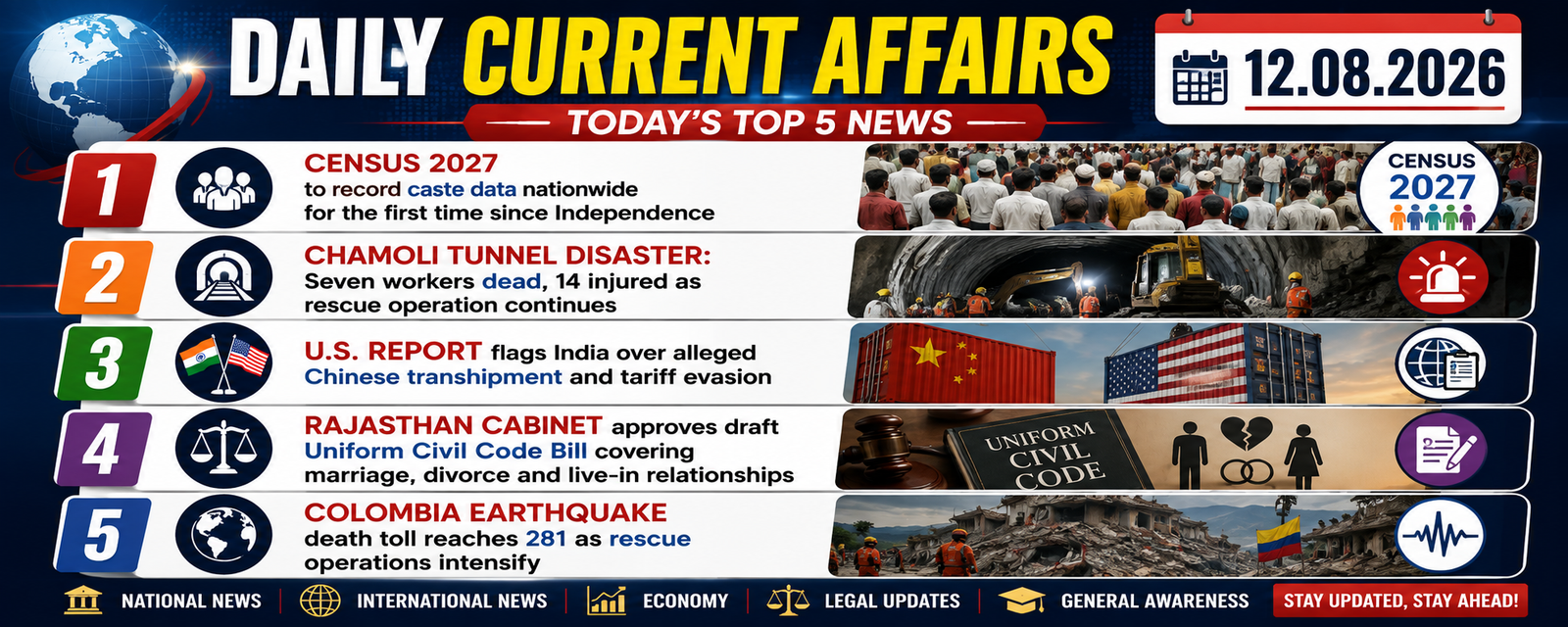
📰 DAILY CURRENT AFFAIRS | 12.08.2026
1. Census 2027 to record caste data nationwide for the first time since Independence
Keywords: Census 2027, Caste Enumeration, Social Justice
The Union Government has notified the 40-question questionnaire for the Population Enumeration phase of Census 2027, introducing a historic change by including an explicit question on caste for every respondent. Unlike previous post-Independence censuses, where caste enumeration was ordinarily confined to notified Scheduled Castes (SCs) and Scheduled Tribes (STs), the upcoming exercise will collect broader caste information across the population. The move follows the Government's earlier decision to incorporate caste enumeration into the main Census rather than conduct it as a separate survey.
Caste data will be collected during Phase II—Population Enumeration, scheduled primarily for February 2027. Alongside caste, the questionnaire will capture detailed demographic, socioeconomic, educational, migration and other information concerning individuals and households. The exercise is expected to be conducted digitally, with enumerators using mobile applications and citizens having a self-enumeration option. The inclusion of caste data is likely to provide the Government with a more comprehensive demographic picture of India's highly diverse social structure and could become an important database for public policy, welfare programmes and affirmative-action debates.
The decision is politically and constitutionally significant because reliable caste statistics have long been sought by political parties, social organisations and communities seeking greater representation in government employment, education and public institutions. At the same time, the exercise presents considerable administrative challenges, including ensuring accurate selfidentification, handling variations in caste names and spellings, preventing duplication, protecting sensitive personal information and establishing a consistent methodology for classification. How the collected information is subsequently processed and published will also be crucial. The Census exercise could therefore influence future debates over reservation, social justice, representation and resource allocation. Beyond its statistical function, the 2027 Census represents a major shift in the Government's approach to documenting India's social composition and may provide policymakers with demographic information that has remained unavailable through the regular Census for decades.
2. Chamoli tunnel disaster: Seven workers dead, 14 injured as rescue operation continues
Keywords: Chamoli Tunnel Collapse, Pipalkoti, NDRF Rescue
A major construction accident struck Pipalkoti in Uttarakhand's Chamoli district after water, mud and debris suddenly surged into an under-construction tunnel at the Vishnugad-Pipalkoti Hydroelectric Project, trapping workers inside. According to officials, around 22 workers were Daily Current Affairs (12.08.2026) present in the tunnel when the incident occurred. At least seven workers have died, while 14 others were rescued with injuries and shifted for medical treatment. The sudden inflow and collapse created dangerous conditions inside the tunnel, complicating rescue efforts and raising concerns over the safety of workers engaged in infrastructure construction in the geologically fragile Himalayan region.
The National Disaster Response Force (NDRF), State Disaster Response Force (SDRF), police, fire and emergency personnel were mobilised for the rescue operation. Teams worked through water, debris and unstable sections of the tunnel to locate those who remained unaccounted for. Rescue operations were repeatedly complicated by continuing water ingress and difficult underground conditions. Uttarakhand Chief Minister Pushkar Singh Dhami visited the site, reviewed the emergency response and directed authorities to prioritise the rescue and treatment of the affected workers. The State Government has also ordered an immediate inquiry into the circumstances leading to the accident.
The disaster has renewed concerns about construction safety in the Himalayan region, where fragile geology, landslides, seismic activity and unpredictable water movement can create significant risks for tunnelling and hydropower projects. The inquiry will be important in determining whether the collapse resulted from natural geological factors, construction-related shortcomings, inadequate safety measures, or a combination of these factors. Beyond immediate rescue and relief, authorities will face the larger responsibility of establishing accountability and ensuring that safety assessments, emergency exits, monitoring systems and disaster-response protocols are strengthened across similar infrastructure projects.
3. U.S. report flags India over alleged Chinese transhipment and tariff evasion
Keywords: U.S. Tariffs, Chinese Transhipment, India-U.S. Trade
A new report titled “The Great Transhipment Scam” has reportedly placed India among countries accused of facilitating the circumvention of U.S. tariffs imposed on Chinese goods. The report alleges that Chinese manufacturers and exporters are using third-country supply chains to route components and finished products into Western markets, allowing goods of Chinese origin to enter the United States while potentially avoiding the full impact of American trade restrictions. India has been identified as one of the jurisdictions whose industrial and logistics networks are allegedly being used in such arrangements. The allegations have significant implications for India's rapidly expanding manufacturing and export ecosystem.
The report reportedly highlights industrial and logistics corridors connecting Pune, Gujarat and Chennai, suggesting that Chinese-origin components may enter India before undergoing limited processing, assembly, packaging or other commercial operations before being exported onward. The central legal and trade-policy question concerns the rules of origin applicable to such goods. Simply routing products through another country does not ordinarily change their country of origin; substantial transformation and compliance with applicable customs requirements are generally necessary for legitimate reclassification. Any deliberate misdeclaration could expose companies to customs penalties, additional duties and other enforcement measures.
The allegations could create diplomatic and economic complications for India-U.S. trade relations. Washington may increase scrutiny of Indian exports, strengthen customs verification, or demand greater traceability of supply chains. For India, the episode highlights the importance of maintaining transparent rules of origin and preventing its manufacturing infrastructure from being exploited for tariff circumvention. At the same time, allegations in a policy report would require verification through specific customs investigations before wrongdoing can be established against individual companies or sectors. The controversy nevertheless underscores India's growing role in global supply chains and the challenges of balancing foreign investment, manufacturing expansion and strict compliance with international trade rules.
4. Rajasthan Cabinet approves draft Uniform Civil Code Bill covering marriage, divorce and live-in relationships
Keywords: Uniform Civil Code, Rajasthan Cabinet, Live-in Relationships
The Rajasthan Cabinet has approved the draft Rajasthan Uniform Civil Code (UCC) Bill, 2026, marking a major step towards establishing a common civil-law framework governing personal matters across communities in the State. The proposed legislation seeks to bring greater uniformity to laws relating to marriage, divorce, inheritance and succession, while introducing common legal standards irrespective of religious identity. The move follows the work of a committee headed by former Supreme Court judge Justice Ranjana Prakash Desai, which was constituted to prepare the draft and undertake consultations with stakeholders.
A significant feature of the proposed framework is the treatment of live-in relationships. The Bill provides for mandatory registration of such relationships, along with prescribed procedures concerning their legal recognition and documentation. The proposed UCC is also expected to address practices relating to marriage and family rights, including provisions concerning polygamy and equal rights in ancestral property. The Government has presented the framework as an effort to promote legal uniformity, gender equality and greater clarity in personal-law matters. The Bill is expected to be introduced in the Rajasthan Legislative Assembly during its upcoming session, where its provisions will undergo legislative scrutiny and debate.
The proposed legislation has broader constitutional and social implications. Article 44 of the Constitution directs the State to endeavour to secure a Uniform Civil Code for citizens, although the provision forms part of the Directive Principles and is not directly enforceable in court. Supporters argue that common civil laws can promote equality and reduce discrimination, particularly in matters affecting women. Critics may raise concerns regarding religious freedom, cultural autonomy, privacy and the extent to which the State can regulate intimate personal relationships. The Bill's passage will therefore require careful legislative consideration to ensure that uniformity in civil law remains consistent with fundamental rights under Articles 14, 19 and 21 and the constitutional guarantee of religious freedom.
5. Colombia earthquake death toll reaches 281 as rescue operations intensify
Keywords: Colombia Earthquake, Rescue Operations, Disaster Management
The humanitarian impact of the 7.4-magnitude earthquake in western Colombia has deepened sharply, with the confirmed death toll rising to 281. According to the National Disaster Unit, at least 3,971 people have been injured, while 379 remain missing as search-and-rescue teams continue operations across affected areas. The earthquake caused widespread destruction across several regions, damaging homes, public buildings, roads, bridges and other essential infrastructure. More than 100,000 people across 15 administrative departments have reportedly been affected, placing enormous pressure on emergency and medical services.
Rescue teams, firefighters, police personnel, medical workers and specialised disaster-response units have been deployed to the worst-hit locations. Search operations are focusing on collapsed structures and areas where residents may remain trapped beneath rubble. Hospitals are treating large numbers of injured people, while authorities are working to establish temporary shelters and provide food, drinking water, medicines and other essential supplies to displaced communities. The possibility of additional structural failures and aftershocks has complicated rescue efforts, requiring teams to operate with heightened caution.
The scale of devastation has also raised concerns about Colombia's disaster preparedness and structural resilience, particularly in densely populated urban areas and communities located near vulnerable geological zones. Authorities are expected to undertake detailed assessments of damaged buildings before permitting residents to return. In addition to the immediate humanitarian response, the Government will face the longer-term challenge of rebuilding communities, restoring infrastructure and supporting families that have lost homes and livelihoods. The rising number of casualties and missing persons makes the earthquake one of the country's most serious recent natural disasters. The crisis underscores the importance of stronger early-warning systems, earthquake-resistant construction, emergency preparedness and coordinated disaster-management mechanisms to reduce casualties during future seismic events.