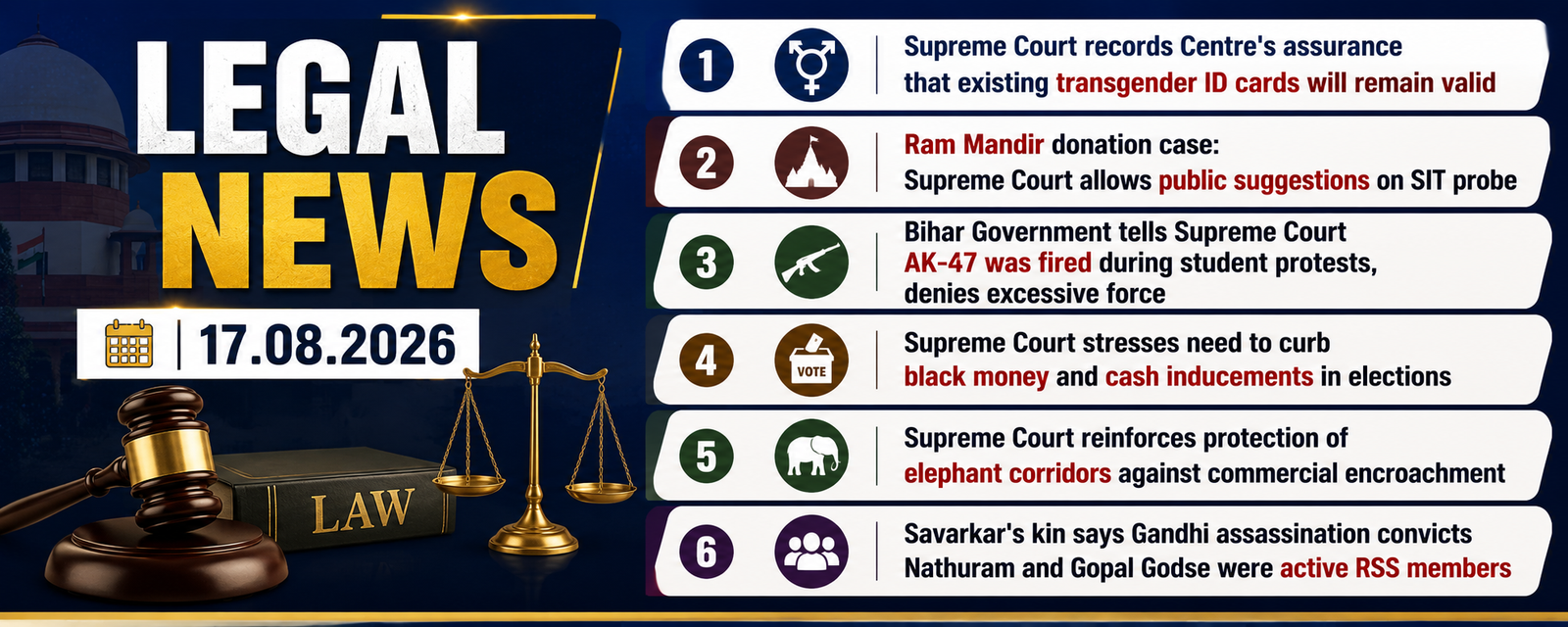
Legal News | 17.08.2026
1. Supreme Court records Centre's assurance that existing transgender ID cards will remain valid
Keywords: Transgender Rights,
Identity Cards, NALSA Judgment
Case Name: Laxmi Narayan Tripathi
and Anr. v. Union of India and Anr. [W.P. (C) No. 548/2026 and connected cases]
The
Union Government has told the Supreme Court that transgender identity cards
already issued under the earlier legal framework will continue to remain valid,
despite the enactment of the Transgender Persons (Protection of Rights)
Amendment Act, 2026. The assurance came during the hearing of petitions
challenging the constitutional validity of the amendment, particularly its
provisions affecting the earlier framework of gender self-identification. The
Bench recorded the Centre's submission, making it subject to the final outcome
of the pending constitutional challenge. The clarification provides immediate
reassurance to transgender persons who already possess government-issued
identity documentation.
The
petitioners, however, raised concerns extending beyond already-issued cards.
They argued that some identity cards had allegedly been cancelled or
incorrectly replaced following the amendment and sought restoration of those
documents. They also highlighted difficulties faced by people awaiting identity
certificates and transgender persons undergoing medical treatment or dependent
on welfare services linked to their recognised identity. The Court indicated
that it would examine specific grievances through individual applications
rather than issuing a blanket direction covering every disputed case. The
petitioners further argued that the earlier 2019 statutory framework,
influenced by the Supreme Court's landmark NALSA v. Union of India judgment,
was based on the principle of self-identification of gender and that benefits
already accrued should not be retrospectively disturbed.
The
issue raises important constitutional questions concerning equality, dignity,
privacy, personal autonomy and non-retrospectivity. The Supreme Court had
previously indicated that a prospective amendment cannot automatically
extinguish rights that had already accrued under the earlier regime. The Court
has now decided to proceed towards final hearing of the constitutional
challenges while continuing to examine individual cases involving cancelled or
defective identity cards. The eventual judgment could determine the extent to
which Parliament can alter the legal framework governing transgender
recognition without undermining previously recognised rights and constitutional
protections.
2.
Ram
Mandir donation case: Supreme Court allows public suggestions on SIT probe
Keywords:
Ram Mandir Donations, SIT Probe, Financial Accountability.
Case
Name: Narendra Kumar Goswami v. Union of India and Ors. [W.P. (C) 790/2026];
Ajay Kumar Rai and Anr. v. Sri Ram Janmabhoomi Teerth Kshetra Trust [W.P.
(Crl.) No. 241/2026]; Sudhankar Singh v. Union of India and Ors. [W.P. (Crl.)
256/2026]; Hindu Dharma Parishad v. Union of India and Ors. [W.P. (C) No.
827/2026]
The
Supreme Court has permitted members of the public and interested stakeholders
to submit suggestions to the Solicitor General concerning the proposed
investigation into allegations of financial irregularities involving donations
collected for the Ram Mandir in Ayodhya. The development comes amid demands for
an independent investigation into allegations of large-scale misappropriation
and financial misconduct relating to temple donations. By allowing broader
public participation at this stage, the Court has sought to ensure that
relevant concerns and suggestions regarding the proposed Special Investigation
Team (SIT) mechanism can be placed before the appropriate authorities.
The
controversy concerns allegations that substantial amounts collected as
donations for the construction and associated activities of the Ram Mandir may
have been improperly handled or diverted. Petitioners seeking judicial
intervention have argued that an investigation by an independent agency is
necessary to establish the authenticity of the allegations, trace financial
transactions and determine whether any criminal offence has been committed. The
Supreme Court's decision does not establish that any theft or misappropriation
actually occurred; the allegations remain subject to investigation and proof.
The
Court's approach is significant from the perspective of public accountability
and transparency, particularly because the temple project has involved
contributions from millions of devotees and members of the public. Any inquiry
into alleged financial irregularities must therefore be impartial,
evidence-based and capable of establishing responsibility without political
interference. Allowing suggestions to the Solicitor General could assist in
determining the appropriate composition, scope, investigative powers and
safeguards applicable to any SIT that may eventually be constituted. The matter
also highlights the broader legal importance of ensuring transparency in the
management of public donations and charitable funds. The Supreme Court is
expected to consider the submissions and determine the appropriate course of
action concerning the proposed investigation.
3.
Bihar
Government tells Supreme Court AK-47 was fired during student protests, denies
excessive force
Keywords:
Bihar Protests, AK-47 Firing, Police Accountability
The
Bihar Government has informed the Supreme Court that an AK-47 rifle was fired
during the recent student protests, but maintained that no protester was
injured by the firing. The submission came while the Court was examining
allegations of excessive police force and misconduct during demonstrations by
students and job aspirants. The State's position is that the police response
was undertaken to maintain public order and prevent protesters from breaching security
arrangements, and that the use of force did not result in the injuries alleged
by the petitioners.
The
Government's explanation is significant because video footage and complaints
concerning the conduct of security personnel had triggered scrutiny over
whether officers used disproportionate measures against demonstrators. The
State has sought to distinguish between the firing of a weapon and any actual
injury caused by it, arguing that the mere presence or discharge of an AK-47
does not by itself establish that unlawful or excessive force was used.
Authorities are expected to provide the Court with additional material,
including ammunition records, deployment details, video footage and reports
concerning the sequence of events.
The
Supreme Court's consideration of the matter involves balancing the State's
obligation to maintain public order with the constitutional rights to peaceful
assembly, expression and personal liberty. The Court is likely to examine
whether the force deployed was necessary, proportionate and authorised under
applicable police protocols. Even where no physical injury results, the use or
display of a firearm during a civilian protest can raise serious questions
concerning intimidation, escalation and adherence to crowd-control standards.
The proceedings may therefore have wider implications for police accountability
and the regulation of force during demonstrations. A judicial assessment of the
evidence could also clarify the circumstances in which law-enforcement agencies
may legitimately employ firearms during public protests.
4.
Supreme
Court stresses need to curb black money and cash inducements in elections
Keywords:
Black Money, Election Expenditure, Voter Inducement.
Case
Name: State of Karnataka & Anr. v. Prathik Parasrampuria [2026 LiveLaw (SC)
816]
The
Supreme Court has issued directions aimed at strengthening mechanisms to
prevent the use of unaccounted cash and other illicit inducements during
elections, observing that the injection of black money into the electoral
process can undermine the foundations of democracy. The Court emphasised that
free and fair elections require voters to be able to exercise their franchise
without being influenced through cash, gifts or other unlawful benefits. The
directions seek to strengthen existing monitoring and enforcement mechanisms
involving the Election Commission of India, Income Tax authorities, police and
other agencies.
The
Court's concerns relate particularly to the movement and distribution of large
quantities of cash during election periods. Existing electoral-monitoring
mechanisms include Flying Squads and Static Surveillance Teams, which monitor
suspicious movement of money and other valuables. The Court stressed that such
mechanisms must function effectively while ensuring that legitimate possession
of cash is not arbitrarily targeted. Where cash is supported by proper
documentation and there is no indication of an electoral offence, authorities
must follow due process rather than treating every large cash transaction as
illegal. At the same time, suspected cash intended for voter inducement must be
promptly investigated, seized where legally justified and subjected to
appropriate proceedings.
The
issue has broader constitutional significance because money power can distort
electoral equality by giving financially stronger candidates or political
organisations an unfair advantage. The Representation of the People Act, 1951
already treats bribery of voters and expenditure beyond prescribed limits as
electoral offences or corrupt practices in specified circumstances. The Supreme
Court's intervention reinforces the principle that electoral integrity requires
not merely conducting polling but also preventing unlawful financial influence
over voters. Effective implementation will depend upon inter-agency
coordination, transparent seizure procedures, rapid investigation,
technological monitoring and strict accountability for electoral violations.
The directions therefore strengthen the wider constitutional objective of
ensuring that elections remain free, fair, transparent and genuinely
representative of the people's will.
5.
Supreme
Court reinforces protection of elephant corridors against commercial
encroachment
Keywords:
Elephant Corridors, Wildlife Conservation, Human-Elephant Conflict.
Case
Name: Prerna Singh Bindra v. Niraj Singhal, IFS [W.P. (C) No. 489/2018]
The
Supreme Court has reiterated that elephant corridors cannot be blocked or
compromised merely by citing concerns about possible harm to people, property
or commercial interests. The Court's approach forms part of its continuing
protection of designated elephant corridors, particularly in the context of the
Segur Plateau in Tamil Nadu's Nilgiris region. The Court has emphasised that
these corridors are essential pathways through which elephants move between
habitats, and that human interference can fragment their natural routes and
threaten the long-term survival of the species. The ruling reflects the
judiciary's emphasis on ecological protection even where conservation measures
create economic or practical difficulties for affected landowners.
The
Court has made clear that commercial activities, resorts and other
encroachments cannot be permitted within protected elephant corridors merely
because their removal may affect existing businesses or private interests. At
the same time, the Court has recognised the legitimate concerns of people whose
livelihoods may be affected by conservation measures, permitting affected
persons to seek alternative sources of livelihood from the concerned
government. This approach attempts to balance wildlife conservation with the
economic interests of human communities without compromising the ecological
integrity of the corridor.
The
decision is significant because human-elephant conflict is often cited as a
reason for restricting or altering wildlife corridors. The Court's position
essentially reverses that logic: rather than blocking wildlife movement because
elephants may come into conflict with humans, authorities must work towards
maintaining safe corridors and reducing encounters through appropriate
planning, habitat protection and mitigation measures. The principle is consistent
with India's broader wildlife-protection framework and the constitutional duty
to protect the environment. Elephant corridors also have ecological importance
beyond individual animals because they maintain connectivity between
populations and support genetic diversity. The ruling therefore strengthens the
legal protection of wildlife corridors and reinforces the precautionary
principle, sustainable development and ecological preservation as important
considerations in land-use and infrastructure decisions.
6.
Savarkar's
kin says Gandhi assassination convicts Nathuram and Gopal Godse were active RSS
members
Keywords:
Satyaki Savarkar, Nathuram Godse, RSS
Case
Name: Satyaki Savarkar v. Rahul Gandhi
A
significant development has emerged in the ongoing criminal defamation case
filed by Satyaki Savarkar against Congress leader Rahul Gandhi before a Special
MP/MLA Court in Pune. During cross-examination, Satyaki—Vinayak Damodar
Savarkar's grandnephew—stated that his maternal grandfather Gopal Godse and his
grand-uncle Nathuram Godse, who was responsible for Mahatma Gandhi's
assassination in 1948, were active members of the Rashtriya Swayamsevak Sangh
(RSS). He also acknowledged that both Godse and Savarkar were among those
accused in the Gandhi assassination case, although their legal outcomes were
different.
Satyaki's
testimony forms part of proceedings arising from allegations that Rahul Gandhi
defamed Savarkar during a speech delivered in London in March 2023. The
complainant alleges that Gandhi made false statements about Savarkar and sought
criminal action under the law of defamation. During cross-examination, Gandhi's
counsel questioned Satyaki about the historical affiliations and political
activities of the individuals connected with the Gandhi assassination. Satyaki
also confirmed that Nathuram Godse was associated with the Hindu Mahasabha,
while Gopal Godse was convicted and sentenced to life imprisonment in the
assassination case. His lawyer objected to several questions concerning the RSS
and Gandhi's assassination, arguing that these matters were beyond the scope of
the defamation proceedings. The judge stated that the objections would be
considered at the stage of final decision.
The
testimony is significant because the historical relationship between Godse, the
RSS, Hindu Mahasabha and Savarkar remains politically and legally contested.
The court has not made any finding on these historical claims merely because
they were stated during cross-examination. The defamation case itself concerns
whether Gandhi's specific statements about Savarkar were false and legally
defamatory. The trial is continuing, with further cross-examination scheduled,
while Satyaki has separately sought a voice sample from Rahul Gandhi to compare
it with the audio recording of the speech at issue.