Daily Current Affairs (17.08.2026)
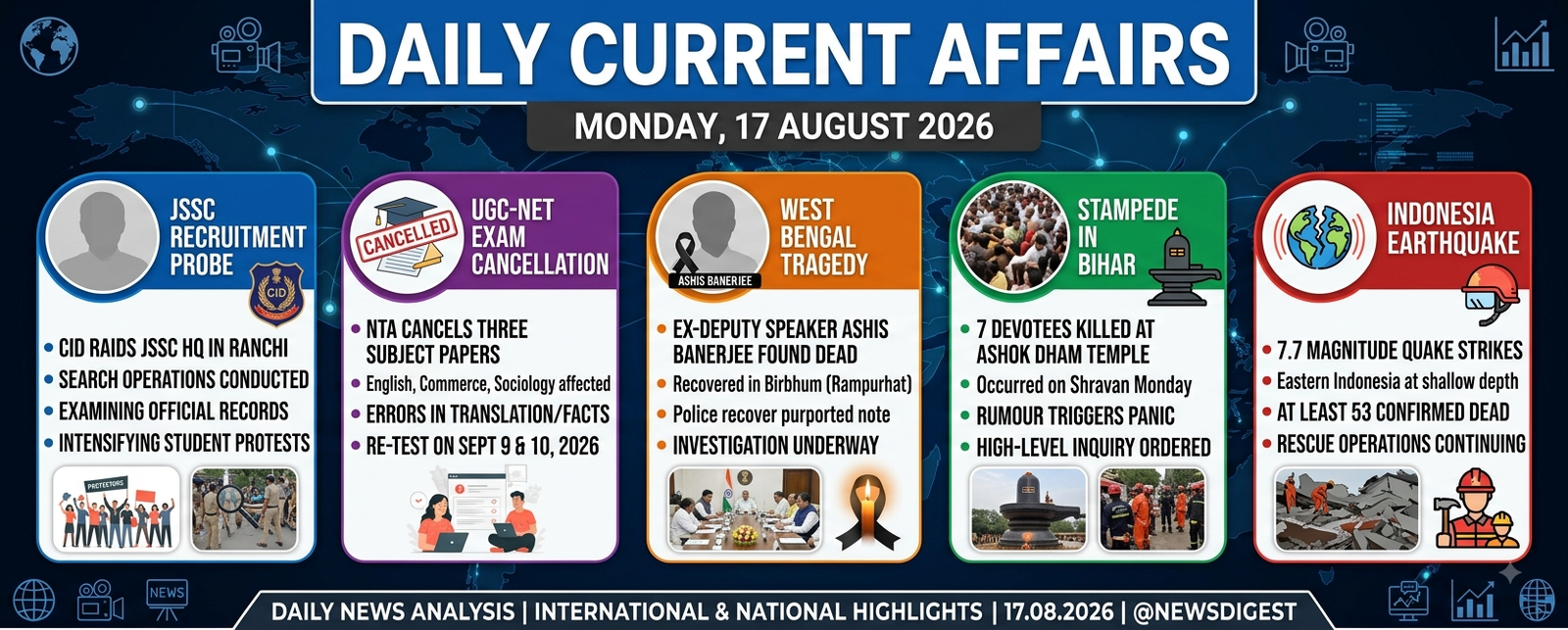
1. JSSC headquarters raided by CID
amid intensifying recruitment protests
Keywords: JSSC, CID Investigation,
Student Protests
The
Jharkhand Criminal Investigation Department (CID) has conducted search and
seizure operations at the headquarters of the Jharkhand Staff Selection
Commission (JSSC) in Ranchi, marking a significant escalation in the ongoing
controversy over alleged irregularities in government recruitment examinations.
The action comes after nearly 24 days of protests by job aspirants and student
organisations demanding greater transparency, accountability and reforms in the
State's examination system. Investigators are understood to be examining
official records, electronic devices and other material that could help
establish whether administrative lapses or organised malpractice occurred
during recruitment examinations.
The
CID operation assumes particular significance because the protests have grown
from examination-specific grievances into a broader movement concerning the
credibility and functioning of the JSSC. Student organisations have alleged
irregularities in examination procedures, delays, and deficiencies in
recruitment administration, while demanding action against those responsible.
The continuing agitation has also created political pressure on the Jharkhand
Government, with student fronts reportedly preparing a march towards the Chief
Minister's residence to press their demands. The Government, meanwhile, faces
the difficult task of maintaining public order while responding credibly to the
concerns of thousands of affected aspirants.
The
search operation could provide investigators with documentary and digital
evidence necessary to determine whether the allegations have a factual basis
and whether individual officials or external networks were involved. The
development also highlights the importance of independent investigation in
examination-related controversies, particularly where public recruitment is
concerned. Competitive examinations determine access to government employment,
making their credibility directly relevant to equality of opportunity and
public confidence in State institutions. If substantial wrongdoing is
established, authorities may have to consider stronger enforcement, examination
reforms and accountability measures. At the same time, any investigation must
follow due process and ensure that responsibility is established on the basis
of evidence rather than allegations alone. The CID action could therefore
become a crucial turning point in resolving the prolonged JSSC recruitment
controversy.
2. NTA cancels UGC-NET papers for
three subjects over translation and factual errors
Keywords: UGC-NET 2026, NTA,
Re-examination
The National Testing Agency (NTA)
has cancelled the June 2026 UGC-NET examination for three subjects—English,
Commerce and Sociology—after an expert review identified multiple factual and
translation-related errors in the question papers. The decision affects
candidates who appeared for these subjects and reflects the agency's effort to
maintain the accuracy, fairness and credibility of the national eligibility
examination. The cancellation follows scrutiny of the question papers by a
specialised expert committee, which reportedly found errors significant enough
to warrant conducting fresh examinations rather than relying on the existing
results.
The NTA has announced that
re-examinations will be conducted on September 9 and 10, 2026, with affected
candidates required to appear for the revised examination. Importantly,
candidates will not be required to pay an additional examination fee, ensuring
that the administrative error does not impose a further financial burden on
them. The agency is expected to issue detailed schedules, examination-centre
information and other instructions to the affected candidates before the
revised tests. The decision also highlights the importance of rigorous
question-paper preparation, particularly for examinations conducted across
multiple languages and large geographical areas.
The development has wider
significance because UGC-NET determines eligibility for Assistant Professor
appointments and Junior Research Fellowships in Indian universities and
colleges. Errors in examination papers can therefore have direct consequences
for candidates' academic careers and research opportunities. The cancellation
demonstrates that examination authorities may need stronger quality-control
mechanisms, including multiple layers of expert review, language verification,
subject validation and technological checks before question papers are
finalised. At the same time, conducting a fresh examination seeks to restore
confidence in the process and ensure that every candidate is evaluated on an
equal footing. The episode once again underscores the importance of accuracy,
transparency and accountability in high-stakes national examinations.
3. Former West Bengal Deputy Speaker
Ashis Banerjee found dead in Birbhum
Keywords: Ashis Banerjee, Birbhum, TMC
Senior
Trinamool Congress leader and former West Bengal Assembly Deputy Speaker Ashis
Banerjee was found dead at a party office near his residence in Rampurhat,
Birbhum, triggering shock and political controversy across the State. Banerjee,
a five-time MLA who represented Rampurhat for several terms, was found hanging
on Sunday morning. Police recovered a purported handwritten note from the
premises, while his body was sent for post-mortem examination. Authorities have
begun an investigation to establish the circumstances surrounding his death,
and the contents and authenticity of the note are also being examined.
The
death assumes additional political significance because Banerjee had recently
experienced considerable changes in his political career. He lost the 2026
Assembly election from Rampurhat to the BJP's Dhruba Saha and subsequently
stepped down as chairman of the TMC's Birbhum district core committee, although
he remained associated with the party. Reports indicate that his resignation
was accompanied by criticism concerning the functioning of the party
organisation. The purported note reportedly denied allegations of corruption
and claimed that Banerjee had never taken money improperly or participated in
alleged wrongdoing connected with local administrative bodies. However,
investigators have not yet established whether the note was genuinely written
by him or what circumstances led to his death.
The
incident has triggered competing political reactions and demands for a
high-level investigation. Opposition leaders have raised questions about
possible political or organisational pressures, while authorities have
maintained that the investigation must establish facts before any conclusions
are drawn. The case therefore involves both a personal tragedy and significant
political implications, particularly because Banerjee was a prominent public
figure with a long legislative career. The post-mortem examination, forensic
investigation, verification of the purported note and examination of people
associated with him will be crucial in determining the circumstances of his
death. Until those processes are completed, allegations concerning possible
coercion, corruption or political pressure remain unverified.
4.
Ashok
Dham temple stampede: Seven devotees killed in Bihar as crowd surges
Keywords:
Ashok Dham, Bihar Stampede, Crowd Management
A
deadly stampede at the Ashok Dham Temple in Lakhisarai, Bihar, on Monday left
at least seven devotees dead and more than a dozen injured. The incident
occurred on the third Monday of the holy Shravan month, when thousands of
devotees had gathered at the Shiva temple for prayers and Jalabhishek. The
sudden surge in the crowd reportedly coincided with the arrival of two trains
carrying additional pilgrims. The pressure on the existing crowd-control
arrangements increased sharply, eventually leading to the collapse of bamboo
barricades and a dangerous crowd crush.
The
situation reportedly deteriorated after an electric pole fell, triggering
rumours that a live wire had come into contact with the crowd. The resulting
panic caused devotees to rush in different directions, with several people
falling and others being crushed beneath the crowd. Emergency personnel,
including police, district administration teams and medical workers, were
immediately deployed. The injured were transported to nearby hospitals for
treatment, while authorities worked to restore order and identify the deceased.
The district administration has also initiated a high-level inquiry into the
incident and the circumstances surrounding the crowd-management failure.
The
tragedy has renewed concerns about crowd management and safety infrastructure
at major religious gatherings in India. Large pilgrimages can generate sudden
and unpredictable crowd surges, making controlled entry, clearly separated
movement corridors, adequate barricading, emergency exits, medical facilities
and real-time crowd monitoring essential. The incident also highlights the
dangers created when rumours spread rapidly in densely packed gatherings.
Beyond determining immediate responsibility, the investigation will need to
examine whether adequate preparations were made for the exceptional pilgrim
influx and whether electrical and crowd-control systems met required safety
standards. The disaster underscores the urgent need for stronger
event-management protocols and preventive safety measures at religious sites
during peak festivals.
5.
Indonesia
earthquake: Magnitude 7.7 quake kills at least 53 as rescue operations continue
Keywords:
Indonesia Earthquake, Magnitude 7.7, Rescue Operations
A
powerful magnitude 7.7 earthquake struck eastern Indonesia at a relatively
shallow depth, causing widespread destruction across affected areas and leaving
at least 53 people dead. The intense seismic activity triggered landslides,
damaged roads and communication networks, and caused numerous residential
structures to collapse. The shallow depth of the earthquake amplified ground
shaking in populated areas, increasing the risk of structural failures and
casualties. Emergency authorities immediately activated disaster-response
mechanisms as reports of damaged buildings and people trapped beneath debris
emerged from several locations.
Search-and-rescue
teams, firefighters, police personnel, medical workers and local volunteers
have been deployed to the worst-affected areas. Rescue operations have been
complicated by strong aftershocks, unstable terrain and damaged transport
links, making access to remote communities particularly difficult. Authorities
have established emergency medical facilities and temporary shelters while
assessing the scale of damage. Residents have been advised to stay away from
damaged structures because continuing seismic activity could trigger additional
collapses and landslides. Emergency agencies are also working to restore
essential services and establish communication with communities that may have
become isolated.
The
disaster highlights Indonesia's extreme vulnerability to earthquakes and
related natural hazards. Located along the Pacific Ring of Fire, Indonesia
experiences frequent seismic activity because of the interaction of several
tectonic plates. The latest earthquake demonstrates the importance of
earthquake-resistant construction, effective early-warning systems, community
preparedness and rapid disaster-response capabilities. Beyond the immediate
loss of life, authorities will face significant challenges in providing
long-term shelter, healthcare and rehabilitation for displaced families. Damage
to roads, bridges and other infrastructure could also disrupt supply chains and
humanitarian assistance. As rescue operations continue and aftershocks persist,
the government's immediate priority remains locating survivors, treating the
injured and ensuring the safety of communities in the affected region.